

How RadPair AI Accelerates Radiology Reads
A radiologist-eye view of the AI reporting stack we deploy. What peer-reviewed studies show about AI-assisted dictation, how sub-second latency reshapes workflow, and why throughput gains do not have to come at the cost of accuracy.
Table of Contents
Key Takeaways
- Peer-reviewed studies on AI-assisted radiology reporting show reporting-time reductions of 24% to 44% across modalities and settings.
- RadPair drives intermediate transcript display below 200 ms and full report generation in 2 to 5 seconds, down from 15 to 20 seconds on legacy stacks.
- A radiology-trained speech model is the difference between dictating naturally and fighting the software. Generic STT chokes on terms like "ADPKD" or "tib-fib."
- AI-assisted reporting in published literature also correlates with accuracy and confidence gains. Faster reads do not mean sloppier reads when the model is purpose-built.
- With a 35% projected radiology workforce shortfall, throughput is no longer a productivity metric. It is a patient-access metric.
1. The Workforce Math
There are roughly 37,000 practicing radiologists in the United States. Imaging volume grows about 5% annually. Residency slots do not. The Association of American Medical Colleges has projected a physician shortfall across the board by 2036, and radiology sits near the top of the affected specialties. Industry-side modeling of throughput against demand puts the radiology-specific gap at roughly 35% unless productivity per radiologist increases materially.
You cannot train your way out of a gap that size on any reasonable timeline. You can hire, you can restructure, you can outsource across time zones. Every one of those levers has been pulled. The remaining lever is the one sitting on every reading workstation: the reporting stack.
For the past two decades, that stack was a dictation engine and a macro library. Radiologists spoke, generic speech-to-text transcribed, and templates filled. The bottleneck was always the same: the software was a passive recorder, not a collaborator. That is what has changed.
2. What RadPair Actually Does
RadPair is a web-based, generative-AI reporting platform for radiologists. No installation, no local GPU requirement, no macro library to maintain. You speak, the system generates a structured report in near real time, and a click-and-drag editing layer lets you revise any sentence, bullet, or finding without retyping.
The platform ships with pre-tuned models rather than expecting each practice to train its own. That matters operationally. In-house model training has been the primary reason generative AI has stayed out of most community radiology practices. The compute cost, the data-governance overhead, and the radiologist-hours required to label training data kept these tools confined to a handful of academic centers. Pre-tuned models collapse that barrier.
Four capabilities do most of the heavy lifting:
- Radiology-trained speech-to-text. The STT layer is tuned to medical shorthand and modality-specific vocabulary. Generic STT engines misfire on terms like "ADPKD," "tib-fib," or "T2 hyperintensity." A purpose-built model handles them natively.
- Generative structuring. Rather than dropping raw dictation into a template, the model generates findings and impressions in the structure the study type requires, pulling from the clinical context attached to the order.
- Click-and-drag editing. When a finding needs to move, change, or be re-weighted in the impression, you drag it. No cursor gymnastics, no "select all and retype."
- WINGMAN co-pilot. A contextual assistant surfaces prior studies, flags inconsistencies between your dictation and the imaging findings it can verify, and offers structured suggestions for impression language.
In November 2025, RadPair released PAIRsdk, a developer framework for building agentic workflows on top of the platform, and launched PAIR 3.0 at RSNA 2025. The practical effect is that routing, worklist prioritization, and QA checks can be triggered by agents that hand off to each other without a radiologist needing to click between applications.
3. What Peer-Reviewed Studies Show
RadPair itself is new enough that its vendor-specific outcomes data is still accumulating. The surrounding literature on AI-assisted radiology reporting, however, is robust and consistent. The direction of effect is not in dispute. Only the magnitude varies by study design, modality, and baseline workflow.
A 2025 qualitative assessment in Academic Radiology examining AI-generated radiology reports on positive findings reported mean reporting time dropping from 6.1 to 3.43 minutes. That is a 44% reduction, with accuracy scores simultaneously rising from 3.81 to 4.65 on a five-point scale and reader-confidence scores rising from 3.91 to 4.67.
A 2025 observational study in the European Journal of Radiology focused on leg and foot radiographs found measurement time dropping from 166 seconds to 40 seconds and reporting time from 80 seconds to 33 seconds with AI assistance. For high-volume extremity practices, those numbers compound quickly across a shift.
A prospective clinical evaluation published in 2024 reported interpretation time dropping from a baseline mean of 189.2 seconds to 159.8 seconds with AI model assistance in live clinical practice, a 15.5% documentation-efficiency gain that held up outside the artificial conditions of retrospective study design.
A pilot study in npj Digital Medicine (2025) evaluating keyword-based AI assistance in resident workflows found median reporting-time reductions of 27.1% and 28.8% across two study types, with a pooled mean of 28.0%. An earlier 2024 workflow study documented a reduction from 573 seconds to 435 seconds, a 24% improvement, without degradation in report quality metrics.
A structured narrative review in European Radiology (2024) pulled these findings together and summarized the field: among published studies of AI-assisted radiology workflow, roughly two-thirds reported measurable time reductions, with gains concentrated between 15% and 44% depending on modality and study design.
The floor on these numbers is meaningful. Even at 15%, a radiologist reading 50 studies a shift reclaims roughly 45 minutes. At 30%, it is an hour and a half. Over a year, that is the equivalent of adding a part-time radiologist to the schedule without adding a salary line.
4. Why Sub-Second Latency Reshapes Workflow
In a 2025 case study published by Fireworks AI, RadPair's infrastructure partner, the team reported reducing full report-generation latency from 15 to 20 seconds down to 2 to 5 seconds. Intermediate transcript display sits under 200 milliseconds. Speech-to-text end-to-end is sub-second.
The temptation is to look at those numbers as incremental performance improvements. They are not. They are the difference between dictation as a batch operation and dictation as a conversation.
Consider what happens at 15 seconds of round-trip latency. The radiologist dictates a finding, pauses, waits, reviews, corrects, and moves on. The context switch between speaking and reading the generated text is constant. The cognitive cost is not the seconds themselves. It is the interruption pattern.
At sub-200 ms, the generated text appears as the radiologist is still speaking. Errors are caught in-stream rather than in a post-hoc review. The radiologist stays in the imaging study rather than ping-ponging between PACS and the reporting window. This is the same effect that made low-latency autocomplete transformative for software engineering and that made live captioning workable for broadcast. Latency is not a feature. It is a workflow.
The Fireworks case study also notes throughput numbers that matter at scale: the platform supports 1,000 or more simultaneous microphones and sustains 100 to 200 reports per physician per day with no degradation in latency as load climbs. For a high-volume practice running overnight coverage, that ceiling is the one that determines whether a system can actually replace the incumbent stack rather than supplement it.
5. The Accuracy Tradeoff That Isn't
Every radiologist considering an AI reporting stack asks the same question first. Faster is fine, but what about accuracy? The concern is legitimate. Speed at the cost of missed findings is a bad trade at any scale, and the history of radiology software is littered with tools that promised efficiency and delivered noise.
The published evidence on current-generation systems does not support the concern. The 2025 Academic Radiology study already cited showed accuracy improving from 3.81 to 4.65 and confidence from 3.91 to 4.67 alongside the 44% time reduction. The Fireworks-RadPair case study reported a 12% reduction in transcription and reporting errors, driven primarily by the radiology-trained STT model handling domain-specific shorthand that generic engines mishear.
Two mechanisms explain the dual improvement. First, fewer transcription errors mean fewer downstream corrections that introduce new errors. Second, the model's ability to surface prior studies and flag internal inconsistencies creates a QA layer that was never feasible with template-based tools. A finding described in the body that does not appear in the impression gets caught before sign-off rather than by a worried referring clinician three days later.
None of this replaces the radiologist. Every report that leaves our practice is signed by a board-certified radiologist who takes full clinical and legal responsibility for the final read. The AI generates a draft structured in the format the study type requires. The radiologist interprets the images, edits the draft, and signs the report. That division of labor matters for quality and for liability, and it is non-negotiable.
6. How We Deploy It at Expert Radiology
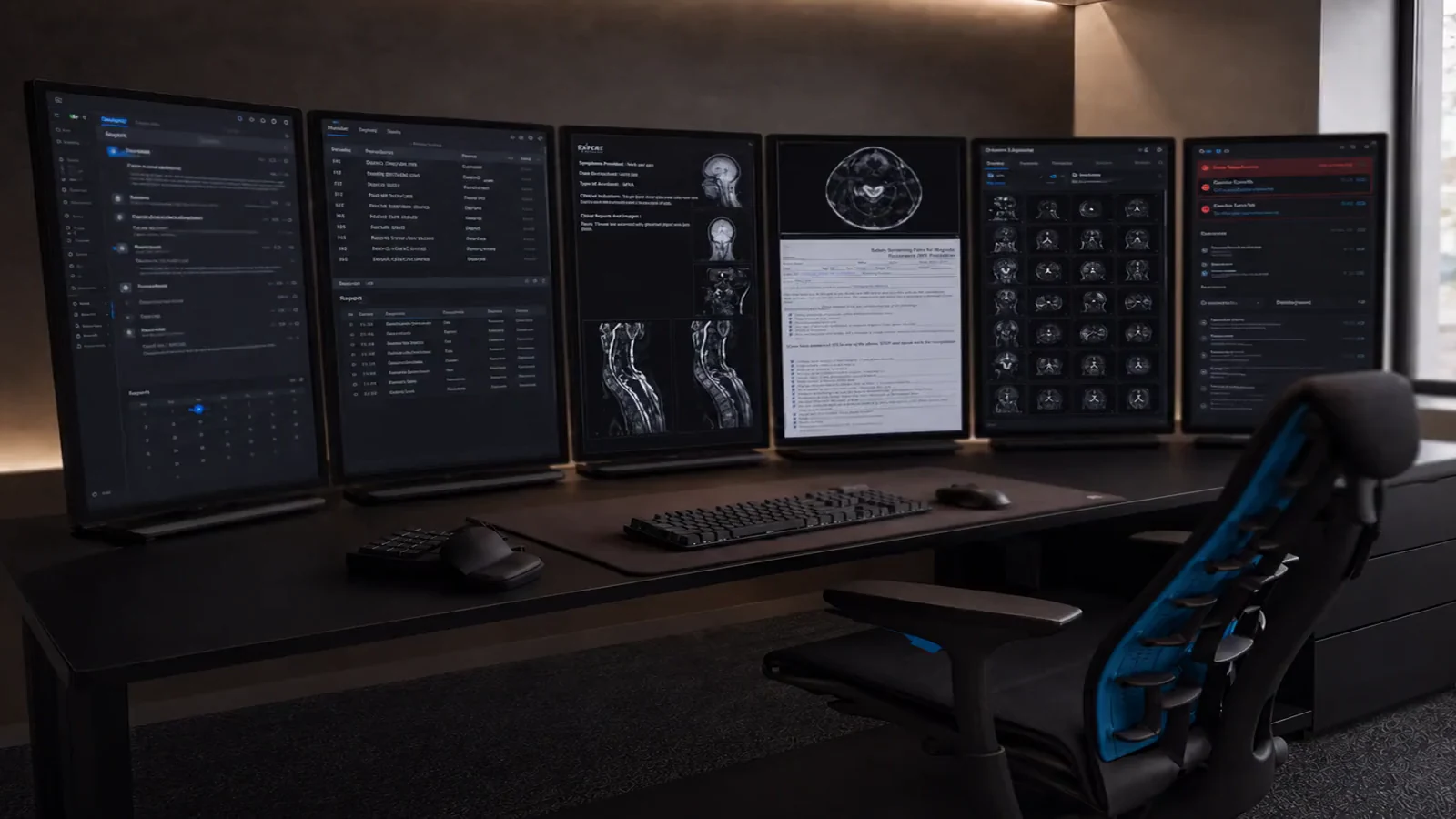
Expert Radiology runs PrecisionPlus v3™, our illustrated MRI reporting product, across a national network of facilities. Studies route to board-certified radiologists with relevant subspecialty expertise: neuroradiology, MSK, spine, or body. RadPair sits on the reporting side of that workflow as the drafting and dictation layer.
The concrete benefits we have seen since deployment break into three buckets. First, time to first read: priority-aware routing and visible case status get easier to protect as volume grows. Second, language quality: the generated drafts are structured in the format our attorney and imaging-center customers expect, which reduces the time our radiologists spend restructuring sentences and increases the time they spend on interpretation. Third, consistency across readers: the same study type generates a draft in the same structure regardless of which radiologist is assigned, which matters for the imaging centers who see reports from multiple ExRad physicians across their referral base.
On the integration side, RadPair connects to the PACS, the worklist, and the delivery pipeline that pushes final reports to the ExRad Portal and to the imaging center's EMR. The radiologist does not see an application-switching problem. They see imaging, they see context, they see a draft, they dictate.
One operational detail worth naming. RadPair's generative layer does not override our commitment to clear confidence language in v3™ reports. The model can produce imprecise wording when the source vocabulary permits it. Our house style and QA process revise that language before sign-off so supported findings are direct and genuine uncertainty is preserved. The AI is a drafting tool. The style is ours.
7. What This Means for Radiologists
The honest answer is that the reporting-stack question is becoming a career-decision question. Radiologists evaluating where to read have always weighed case mix, compensation, subspecialty fit, and call load. Reporting infrastructure was an afterthought. It does not pay to be an afterthought anymore.
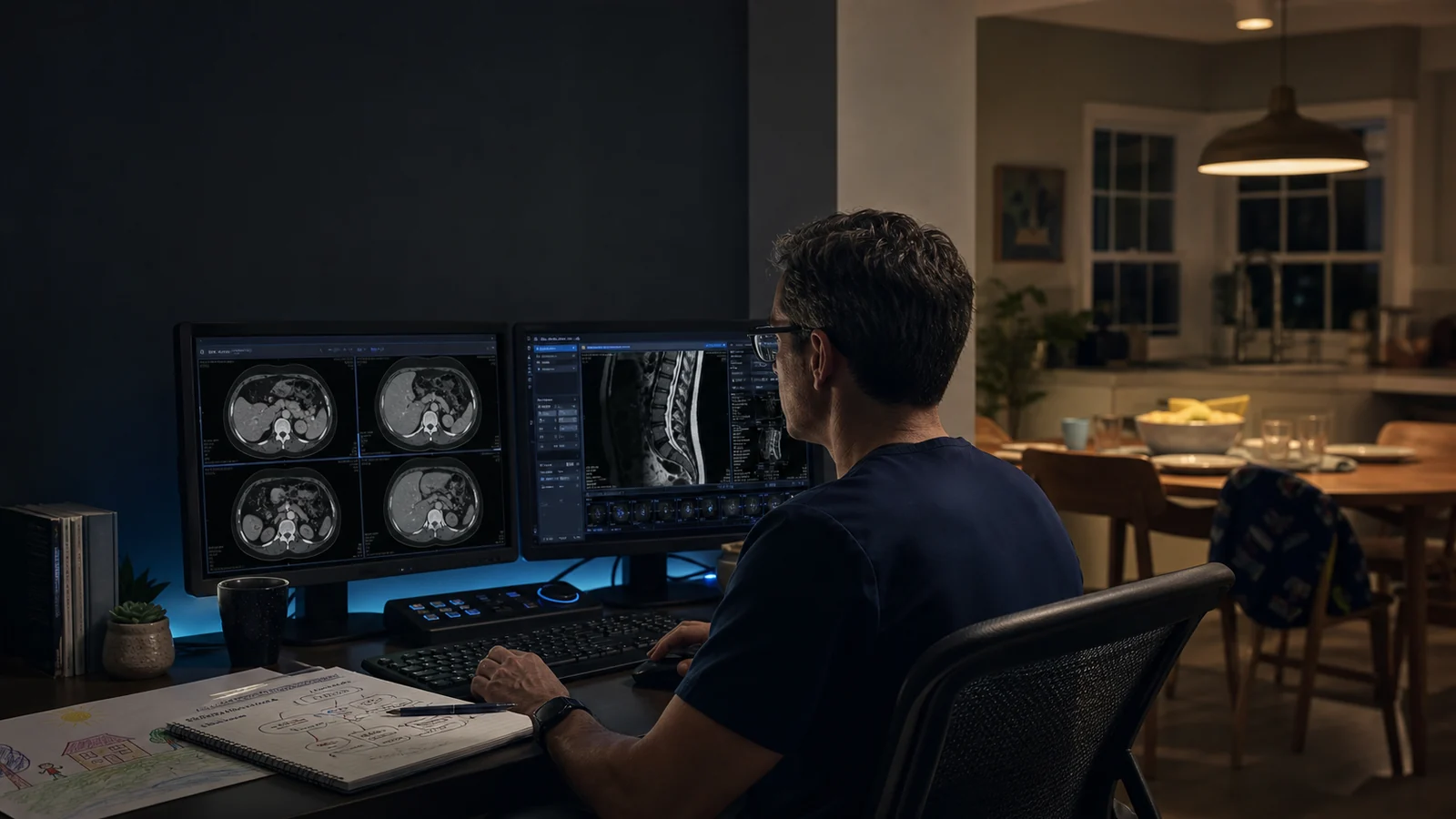
If you read 40 studies a shift on a legacy dictation stack and your colleague two cities over reads 55 on a modern AI-native stack, your compensation-per-RVU math is different, your burnout trajectory is different, and your ability to carve out protected time for subspecialty development is different. None of that is about working harder. It is about the tools on the workstation.
There is also a skills question. The radiologists who will be most valuable in five years are the ones who understand how to work with a generative model, where its errors concentrate, how to structure a prompt or a correction, and when to override it. That is not a skill you acquire by reading about AI in the trade press. It is a skill you acquire by using the tools in production.
For radiologists evaluating Expert Radiology specifically, the tooling is one piece of a larger thesis. We pair subspecialty-fit case routing with a modern AI-native reporting stack and a structured illustration pipeline that makes our reports the most differentiated product in the market. The workstation experience is the daily experience. We have invested accordingly.

Written by
Avery J. Knapp Jr., M.D.
Board Certified Radiologist, Neuroradiology

Medically reviewed by
Chad Barker, M.D.
Musculoskeletal Specialist
Sources
- Association of American Medical Colleges. The Complexities of Physician Supply and Demand: Projections From 2021 to 2036. AAMC. 2024.
- Evaluating the Accuracy and Efficiency of AI-Generated Radiology Reports Based on Positive Findings: A Qualitative Assessment of AI in Radiology. Academic Radiology. 2025;32(S1076-6332(25)00865-7).
- Observational evaluation of AI-assisted measurements and reporting for enhanced workflow efficiency in leg and foot radiographs. European Journal of Radiology. 2025.
- AI model saves time in live radiology clinical practice setting. AuntMinnie / prospective clinical evaluation. 2024.
- Keyword-based AI assistance in the generation of radiology reports: A pilot study. npj Digital Medicine. 2025.
- AI in radiology and interventions: a structured narrative review of workflow automation, accuracy, and efficiency gains of today and what's coming. European Radiology. 2024.
- Fireworks AI. Modernizing Healthcare with AI: How RADPAIR and Fireworks Unlock Smarter Radiology Workflows. Fireworks AI case study. 2025.
- RADPAIR. Launches PAIRsdk and Announces Industry Coalition to Build the Foundation for Agentic AI in Radiology. PR Newswire. November 2025.
- Intelerad Partners with RADPAIR to Speed Up Radiology Reporting. HIT Consultant. May 2025.
- RamSoft and RADPAIR Announce Integration of AI-Driven Radiology Report Generation. RamSoft press release. 2024.