

Midjourney Asked Us to /imagine Replacing Every MRI.
A Radiologist Did the Math and Responds.
Avery J. Knapp Jr., M.D. reads Midjourney Medical as a radiologist: the history that argues for patience, the physics that argues for skepticism.

Table of Contents
A neuroradiologist sounds off on Midjourney Medical's whole-body ultrasound scanner: the history that argues for patience, the physics and arithmetic that argue for skepticism, and why a diagnostic tool should not launch in a spa.
Section 1 The History Argues For Humility
In June 2026, Midjourney, the company most people know for turning text into pictures, announced that it now wants to turn you into a picture. Its new division, Midjourney Medical, unveiled a whole-body scanner it calls "Ultrasonic computed tomography" (USCT). You step onto a platform, descend into a pool of water, and a ring of what the company describes as roughly half a million tiny ultrasound elements maps your body in what the company says will be under sixty seconds, with no radiation and no magnets. The initial machines are meant to live inside a flagship "Midjourney Spa" in San Francisco, somewhere between the saunas, the cold plunges, and rooms bathed in pools of golden light. [1][2][4][14]
I read MRI and run a company, Expert Radiology, that primarily interprets MRI for a living, so I have an obvious bias and I will name it up front: I want better imaging to exist, and MRI is often the best currently available test for certain body parts, depending on the clinical indication. I want medical imaging to be faster, safer, and cheaper, and I would happily be put out of a particular job by a machine that genuinely serves patients better. I want medical imaging to be like the medical tricorders in Star Trek, instantly able to see inside the entire body, and on a molecular level. So this is not a takedown. It is a reading, the same kind I do all day, of what Midjourney actually showed, what was actually claimed, and what the evidence will and will not support.
The easiest and laziest thing a radiologist can do is laugh at a new modality because its first images look bad. I will not, because every modality saving lives every day started out looking bad.
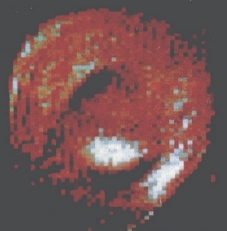
The first published human MRI body image, produced by Raymond Damadian and his team in 1977, took nearly five hours to produce a single grainy cross-section of a human chest. Other early MRI images, including an early human finger image, were similarly crude. The first published MR image of a human brain showed little more than the ventricles and the eye sockets. Within about a decade, MRI went from that smudge to the single most informative radiology test in medicine. So I am not going to mock a twenty-minute prototype for being slow, and I am not going to mock early ultrasound images for being crude. Slow and crude is how this always starts. [9]
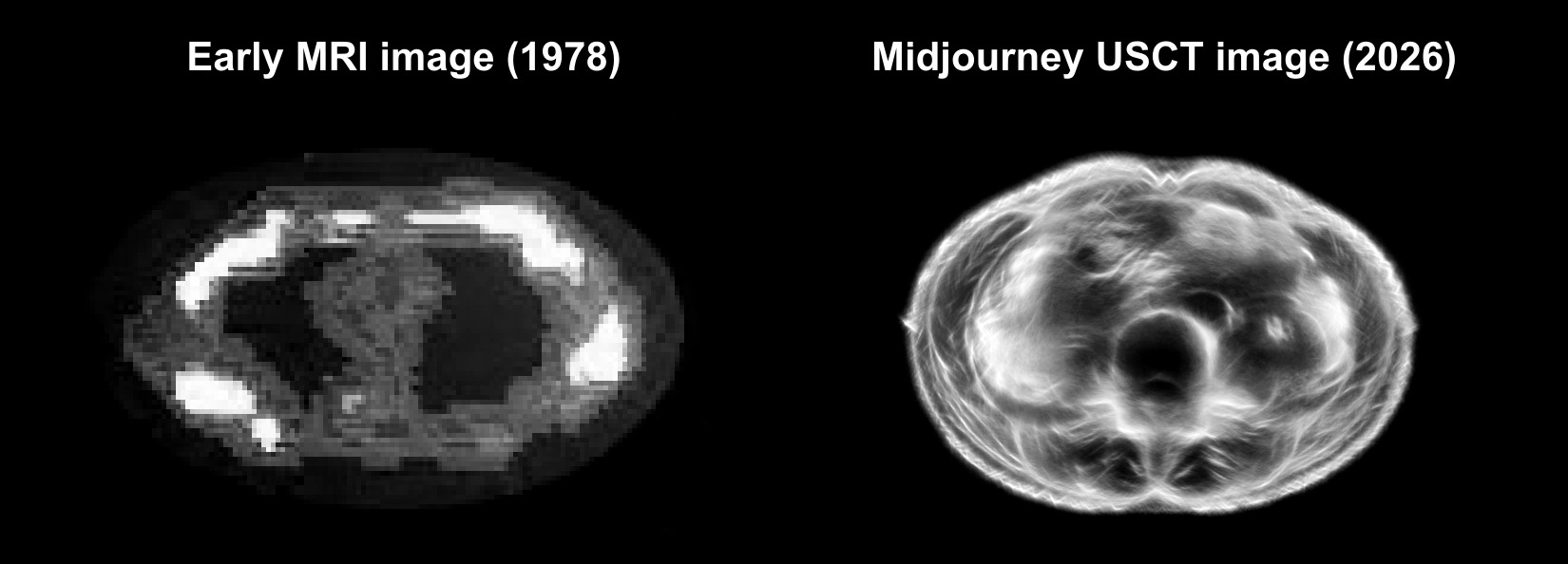
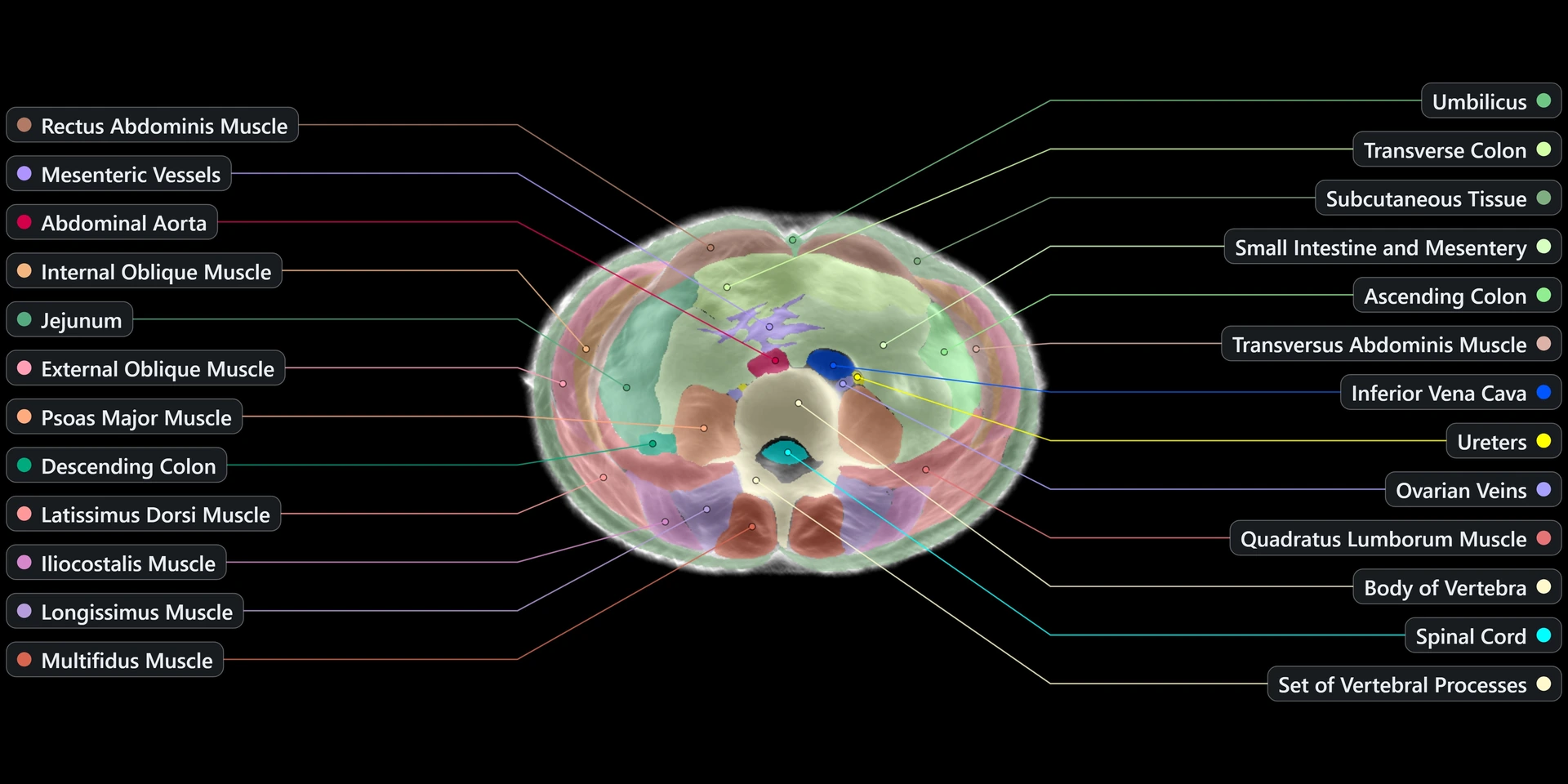
The superficial muscles and structures look pretty good. But it is a bit aggressive to confidently colorize deeper anatomy when gray-scale contrast between the psoas muscle and adjacent fat, or between jejunum and ileum, is limited. Those superficial structures are not usually where the common pathology lives, and deeper bowel that contains air is not very useful at this point.
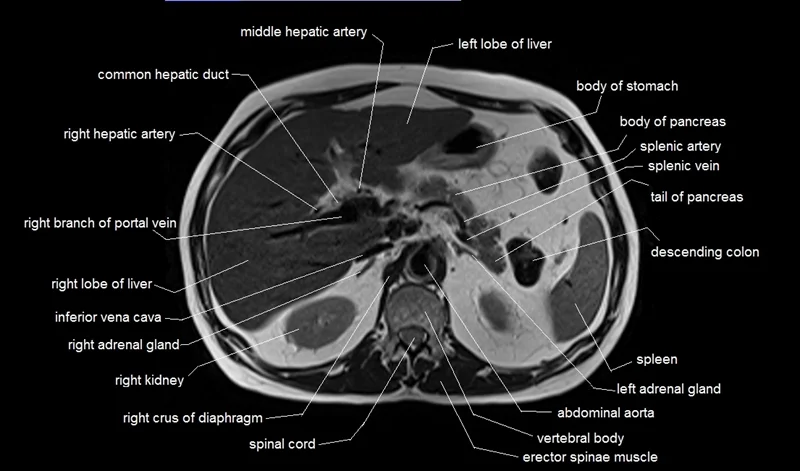
Compare this with a modern MRI image clearly delineating various organs.
There is even a charming precedent for an unlikely company entering medical imaging. The first clinical computerized tomography scanner was built by Godfrey Hounsfield at EMI, the British firm whose record label happened to be home to the Beatles, and the profits from that catalog helped underwrite the research lab where he worked. [10] Hounsfield shared the Nobel Prize in 1979. A company that sells one kind of image deciding to fund another kind is not, by itself, a punchline. CT earned its place. So did MRI. So did ultrasound. But whole-body ultrasound?
If Midjourney spends the next ten years quietly improving image quality and publishing it, I will be glad. But there is a difference between a problem that time and human or artificial ingenuity solves and a problem that physics cannot.
Section 2 The Physics Has A Ceiling That Money Cannot Raise
MRI's early problem was resolution and speed. Those are engineering problems, and engineering problems yield to better magnets, better coils, and faster computers. The history of MRI is the history of that yielding.
Ultrasound's central limitation is not only engineering. It is physics. Sound does not travel usefully through bone or through air. At the boundary between soft tissue and bone, or between soft tissue and gas, almost all of the sound energy is reflected, which is exactly why a cardiologist has to aim an echo probe between the ribs, why we cannot generally image an adult brain through the intact skull with ultrasound, and why we do not screen the lungs with it. The lungs are full of air. Much of the bowel is full of gas. The brain sits inside a closed box of bone.
No number of sensors and no amount of artificial intelligence changes that. You can add half a million transducers, or five million, and the sound still stops at air, bone, and the lungs. This is why describing a water-bath ultrasound device as a "full body" alternative to MRI is, charitably, a category error. Ultrasound can be very good at some soft tissue, and it is blind to several of the places we most need to see. A tool that cannot evaluate the brain, the lungs, or much of what hides behind bone is not competing with MRI. It is doing something else and borrowing MRI's name for the comparison. To be clear, MRI of the lungs is also not currently very useful because of breathing motion.
It is also worth saying plainly that whole-body ultrasound is not a new idea. Whole-body ultrasound tomography has been studied for decades, including for the breast, where it has never displaced mammography or breast MRI. I was talking about whole-body ultrasound as a neat concept in residency twenty years ago. The genuinely new thing here is not the modality. It is the marketing.
Section 3 The Arithmetic Does Not Survive Contact With A Calculator
In medicine we are expected to be accurate, so let me be accurate about the numbers the company is putting into the world.
Midjourney has said that ten of its scanners would be able to perform more body scans per year than every MRI machine on Earth combined, and MobiHealthNews reported that by 2031 a fleet of fifty thousand could deliver a billion scans a month. [1][3] The first statement is patently untrue using the company's own math. The second is the kind of claim that sounds visionary until you do the division.

Midjourney claims in its technical video, not a white paper, that less than a dozen of these systems operating at full speed can do more full-body scans than every MRI machine together on Earth. It takes roughly 60 to 90 minutes to do a whole-body scan on an MRI, and whole-body MRIs generally do not include arms and legs because that is usually not clinically useful. Global MRI volume is conservatively more than 100 million exams per year. [11]
The annual version makes the scale clearer. A single scanner running every minute of every day, with zero patient turnover, would perform 525,600 scans per year. Ten scanners would perform about 5.26 million scans per year, roughly 5 percent of global MRI volume, not more than all MRI machines on Earth. To truly exceed 100 million exams at that flawless cadence, the company would need roughly 190 machines; with real patients entering water, positioning, exiting, drying, dressing, and cleaning between scans, the practical requirement climbs from hundreds toward thousands.
The billion-scans-a-month claim has the same problem. A fleet of 50,000 scanners would need 20,000 scans per machine per month, about 667 per day, or about 28 per hour every hour of every day. At a true 60-second scan, that means running for roughly half of every 24-hour day forever before turnover. At the current reported 20-minute prototype speed, it is physically impossible.
And that is the generous version, because the sixty-second scan does not exist yet. By multiple accounts from TechTimes and Engadget, the current prototype, which has scanned only about a dozen people, takes roughly twenty minutes per scan because the system cannot yet move that much data fast enough. [6][7][14] A twenty-minute scan has somewhat better throughput than a typical whole-body MRI, but it is not one hundred times faster. The headline number is not merely optimistic. Today it is inverted.
I do not point this out to embarrass anyone. Early prototypes are slow, and that is fine. I point it out because the company is not marketing a humble prototype. It is marketing a billion scans a month, and the gap between that sentence and the calculator is the whole story.
Section 4 The Spa Is The Tell
Here is the part that moved me from curious to skeptical. A serious diagnostic device does not launch inside a spa.
Spas are wonderful, or so I hear. Saunas, cold plunges, and a quiet afternoon are good for how you feel, and there is nothing wrong with selling that. The videos are excellent marketing, almost cinematic. That is exactly the point. When a company wraps an unproven medical claim in golden light and hot tubs, it is selling the experience rather than the evidence, and it is choosing its venue precisely because the evidence is not ready to do the selling. The most compelling thing a body scanner can show is the inside of a body, clearly, head to toe and without all the labels, the way a CT or an MRI does. The launch materials were full of sleek video and conspicuously short on detailed images of an actual human body. When the proof is in the pudding, you show the pudding.
Clinical MRI earns its place in the hard cases, where the question determines the protocol and the protocol determines whether the study answers anything:
- Acute neurologic symptoms
- Cancer staging and surveillance
- Spine infection or cord compression
- Postoperative complications
- Occult fracture or soft-tissue injury
- Inflammatory disease
- Pediatric and complex specialty protocols
- Cases where the question determines the sequence
There is a deeper problem, and it is the one with the most settled evidence behind it.
Midjourney's model points the scanner at healthy, asymptomatic people on a regular, even monthly, basis. Whole-body screening of people with no symptoms is not endorsed by the American College of Radiology, the Canadian Association of Radiologists, or, to my knowledge, by any major cancer or radiology society, because the evidence does not show that it extends life, and it does show potential real harm. [12][13]
The harm is not hypothetical. In studies of whole-body MRI in the general population, the large majority of people have at least one incidental finding, and by some accounts roughly a third have a finding significant enough to warrant further workup. The overwhelming majority of those findings turn out to be nothing. [12] But you cannot know they are nothing without chasing them, and chasing them means more scans, more biopsies, more anxiety, more cost, and occasionally a complication from a procedure that was never going to help. Whole-body screening is marketed as peace of mind. In practice it too often delivers the opposite: uncertainty, overdiagnosis, and a cascade of follow-up for findings that would never have hurt you. [13] Now imagine that cascade sold by the month, at scale, to a billion well people who walked in for a steam and a scan. The claim that this could avert thirty percent of deaths has no support I can find. The likelier outcome is a great deal of expensive worry.
Section 5 What Would Change My Mind
I am not asking for, or hoping for, Midjourney to fail. I am asking it to meet the same bar every imaging tool I trust has met. Specifically:
- Publish the images. Not marketing renders, the actual reconstructed whole-body studies, ideally next to a matched MRI or CT.
- Submit to independent evaluation by radiologists and institutions that do not work for the company, and let that comparison be peer reviewed.
- Pursue and obtain FDA clearance for diagnostic claims, rather than launching as "body composition" wellness while implying diagnosis. The company's own hardware partner has been careful to call this a roadmap and a vision, and has noted in its filings that clearance may not come on the anticipated timeline, or at all. [8][14] That caution is appropriate. The marketing should match it.
Do those things and USCT may yet earn a real and valuable place, as ultrasound already has in obstetrics, cardiology, breast imaging, musculoskeletal imaging, parts of abdominal imaging, and the emergency department. It may also remain limited in other areas, including bowel outside of hit-or-miss pediatric appendicitis evaluations. That would still be great news.
Section 6 The Quiet Irony
The unspoken premise of an announcement like this is that imaging is a cost to be automated away and that radiologists are a bottleneck to be removed. The last decade has shown the opposite, at least to date. In 2016 the computer scientist Geoffrey Hinton suggested we should stop training radiologists because machines would soon replace them. We did not, and it is a good thing, because demand for imaging has only climbed. As scans get faster and cheaper, we order more of them, not fewer, and someone still has to look, with subspecialty training and accountability, and explain what was found in language a patient can act on. Jevons' paradox, where technological progress that increases the efficiency of a resource can increase overall consumption of that resource rather than decreasing it, is in full display. Again, think Star Trek and medical tricorders.
That is the future I believe in, and it is genuinely exciting: more imaging, earlier answers, better understanding for patients. It will be built on tools that prove themselves on the merits, read by people who are responsible for being right, not sold by the month between the sauna and the cold plunge. Sound has limits. Honesty about those limits is not pessimism about the future. It is the price of being trusted with it.
Avery J. Knapp Jr., M.D., is a neuroradiologist and the founder of Expert Radiology, a teleradiology group striving to create the best reports on the planet.
Sources

Written by
Avery J. Knapp Jr., M.D.
Founder, Board Certified Radiologist