

The Honest Truth About Teleradiology Income
Most radiologists who ask me about joining Expert Radiology have the same first question: "What can I realistically earn?" It's the right question. And the honest answer is that it depends almost entirely on efficiency — not on some formula we give you, but on how you set up your workflow, your environment, and your daily rhythm.
I've been reading teleradiology for over a decade. I've read from home offices, airport lounges, and a beachfront condo in Condado. I've used dictation software that cost me an hour a day in corrections, and I've used AI-assisted transcription that gave me that hour back. The income difference between a radiologist who has dialed this in and one who hasn't is not trivial. It's six figures annually, at the same case volume.
This guide is what I wish someone had handed me on day one. It covers hardware, software, workflow, dictation, case selection, pacing, and the psychology of reading at scale without grinding yourself down.
The income difference between a radiologist who has their workflow dialed in and one who hasn't is not trivial. It's six figures annually, at the same case volume.
Hardware: Stop Underinvesting Here
Most radiologists spend more deliberating over a new car than they invest in a reading station. This is backwards. Your reading station is the instrument you use inside a historical $500–$900+/hr contractor range. A suboptimal setup has a direct, measurable cost.
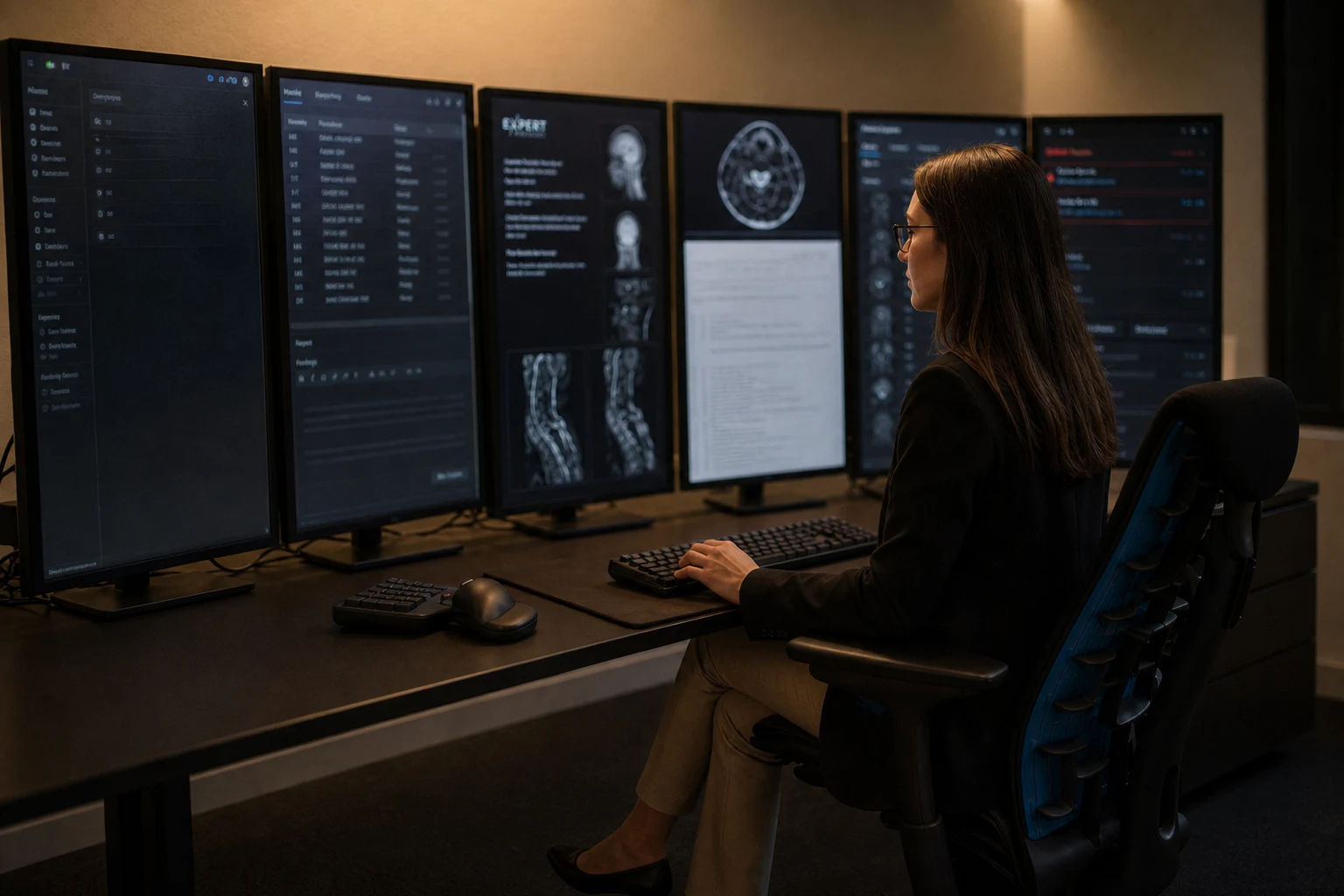
The setup I use and recommend starts with a dedicated workstation and diagnostic displays arranged around the reading workflow. At Expert Radiology, the ExRad Station hardware ships preconfigured, and our team guides the remote setup. If you're building independently, do not cut corners on monitor quality or workstation capacity.
The vertical monitor orientation matters more than most radiologists expect. For spine, MSK, and neuro studies, a vertical diagnostic display means fewer scrolling interruptions per series. That sounds minor. Over a sustained reading month, it adds up to meaningful time savings and reduced cognitive friction.
Lighting and ergonomics deserve serious attention too. Control glare, keep the room comfortable, and choose a reading position you can sustain without repeatedly breaking focus. Those room and furniture choices remain separate from the ExRad Station hardware shipment.
Your reading station is the instrument you use inside a historical $500–$900+/hr contractor range. A suboptimal setup has a direct, measurable cost.
AI-Assisted Transcription: What It Actually Does to Your Speed
I started using traditional voice recognition in my first teleradiology role. My correction time was eating 15–20% of my total reading time. Corrections feel minor in the moment, but they break flow. Flow is where efficiency lives.
At Expert Radiology, we use RadPair AI combined with trained human transcriptionists. The AI handles first-pass transcription with higher accuracy than voice recognition alone, and the human transcriptionists catch edge cases and specialized terminology. The result: reports come back cleaner, corrections are rarer, and I dictate faster because I've learned to trust the output.
The key insight most radiologists miss: AI transcription doesn't just save correction time. It changes how you dictate. When you trust that your words are being captured accurately and you won't have to fix them, you dictate with more confidence and precision. Your reports get better, not just faster.
The Availability Control System
One of the things I built at Expert Radiology that I'm most proud of is the volume control system. Every morning, you tell support how many cases you want that day. Available means support can send cases. Off means the queue stops. It's that simple.
This sounds obvious in retrospect, but it's genuinely rare in teleradiology. Most practices build their schedules around facility needs, not radiologist capacity. The implicit message is that your energy is the variable that should flex.
The availability model treats your reading capacity as something to be managed intelligently rather than depleted. A radiologist who protects quality and flow is more valuable than one who pushes past a sustainable pace and produces lower-quality dictations. The economics bear this out: you can't get paid for a callback-inducing report twice.
A radiologist who protects quality and flow is more valuable than one who pushes past a sustainable pace and produces lower-quality dictations. You can't get paid for a callback-inducing report twice.
Case Mix and Flow State
At Expert Radiology, the case mix is approximately 75% MRI, 20% X-ray, and 5% CT. Roughly 98% noncontrast. Outpatient only. Average patient age around 45.
This is not accidental. We deliberately built a case mix optimized for subspecialty reads without the chaos of ER and ICU emergencies. Clean cases, consistent complexity, predictable workflow. That predictability is worth more than most radiologists realize until they've experienced its absence.
The neuroscience of flow state is relevant here. Cognitive performance peaks when task difficulty is matched to skill level. Too easy: boredom and inattention. Too hard: anxiety and cognitive overload. The outpatient MSK and neuro case load sits in that productive middle range for fellowship-trained subspecialists. You're challenged without being overwhelmed, which is the zone where both speed and quality compound.
The Pre-Read Case Prep Team
One feature of the Expert Radiology workflow that radiologists consistently underestimate until they've experienced it: dedicated case prep. Before a case reaches your queue, a support team has ensured the study is complete, the clinical information is attached, and the prior studies are available for comparison.
Most radiologists outside of this structure spend meaningful time on administrative triage: tracking down incomplete studies, chasing clinical context, requesting comparisons. That time is lost productivity. It doesn't show up in your case count, but it shows up in your hourly rate.
When cases arrive complete and ready to read, your transition time between studies drops significantly. You open a study, read it, dictate, close it, open the next one. That rhythm — unbroken — is where high-output reading happens.
When cases arrive complete and ready to read, your transition time between studies drops significantly. That rhythm — unbroken — is where high-output reading happens.
The Income Math, Worked Out
Let me give you the cleaner version of the math. Expert Radiology's historical contractor range is generally $500 to $900+ per hour, depending on efficiency, case mix, available volume, licensure, and market conditions. At 2,000 reading hours per year, $500/hour annualizes to $1M and $800/hour annualizes to $1.6M.
That's not a guarantee or a promise. It is a benchmark for understanding why workflow, case prep, transcription quality, and sustainable pacing matter. Add the Act 60 structure for PR residents, and the after-tax picture can shift dramatically.
The point isn't to give you a specific number to hold onto. It's to show that efficiency gains — in dictation speed, case prep, flow state, and daily volume control — have a compounding financial effect that most radiologists don't fully account for when they're evaluating an opportunity.
Sustainability: The Part Nobody Talks About
High-output reading is only valuable if you can sustain it. A radiologist who reads at peak capacity for 18 months and burns out is not ahead. The physicians I've seen thrive in teleradiology over 5, 8, 10 years share a few consistent habits.
They stop at a defined time. They don't let "just a few more" become a pattern. They exercise regularly, with the same discipline they apply to their reading schedule. They build non-medical social structures — the Act 60 community in Puerto Rico is a good example of this — so that their identity isn't entirely tied to their output.
They also don't read seven days a week. The goal is a sustainable, transparent rhythm matched to availability, case mix, and quality. You don't have to work every day. And if you're managing your workflow well, you probably shouldn't.
What to Do Next
If you're evaluating teleradiology as a practice model, start by being honest about your current setup. Is your reading station optimized? Is your dictation software costing you 15% of your day in corrections? Are you able to signal volume preference on a day-by-day basis, or are you locked into a schedule someone else built?
The single biggest lever most radiologists can pull is dictation speed. Before anything else, calculate what 15% of your reading time is worth at your current rate. That number often makes the hardware and software investment decision obvious.
If you want to evaluate how this workflow would map to your schedule, subspecialty, and income picture, start with the application. The recruiting process is designed to review fit quickly and keep the next steps practical.